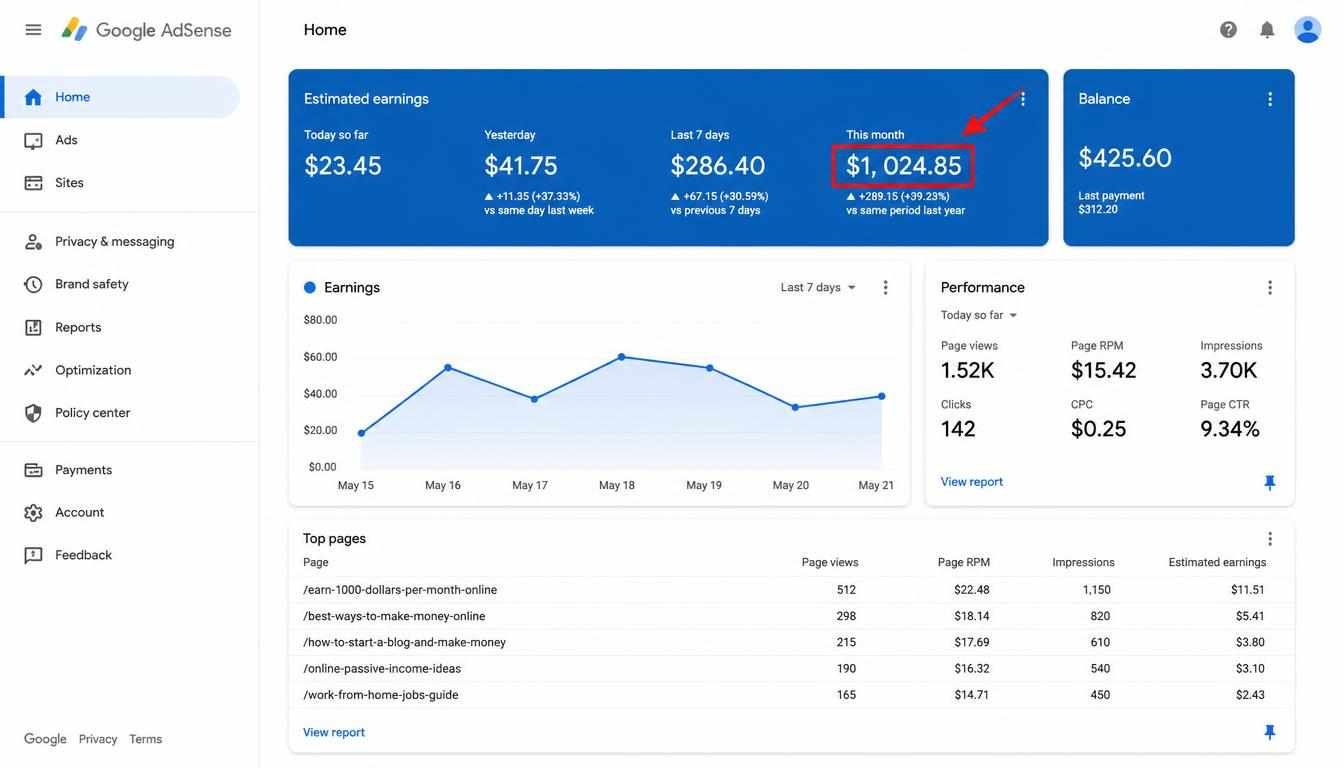
Meta Description: Learn how to earn $1,000 per month with Google AdSense through website creation, quality content, SEO, organic traffic, and smart ad optimization.
When I first thought about making money online, the idea seemed quite simple. I would create a website, publish some articles, get approved for Google AdSense, and start earning money by displaying advertisements. However, once I began exploring the process, I realized that things were not as easy as they seemed. Creating a website can take only a few hours, but attracting regular visitors and turning that traffic into meaningful income requires a completely different level of effort.
Many website owners dream of earning $1,000 per month through Google AdSense. The opportunity to earn in US dollars is especially attractive to people living in countries such as Bangladesh. However, having an AdSense account alone is not enough to achieve this goal. You need useful content, a clear SEO strategy, consistent traffic, and a long-term plan.
In this article, I will explain the practical strategies that can help you build a website suitable for AdSense monetization and gradually work toward the goal of earning $1,000 per month.
1. Understanding How Google AdSense Works
Google AdSense is an advertising program that allows website owners to earn money by displaying advertisements on their websites. Advertisers pay to promote their products and services, while publishers can earn a share of the revenue generated through eligible ad activity.
However, not every visitor generates the same amount of revenue. Some visitors read one page and leave, while others explore several articles. Advertising demand, visitor location, content category, user behavior, and other factors can influence earnings.
One important lesson is that more traffic does not automatically mean more income. Two websites receiving the same number of visitors can generate significantly different amounts of revenue.
Understanding these differences is essential before setting a realistic monthly income target.
2. Why I Chose a Website as an Income Source
There are several ways to earn money online. Some people work as freelancers, others manage YouTube channels, and many create content for social media platforms. One advantage of running a website is that a useful article can continue attracting visitors long after publication.
For example, imagine publishing a detailed guide that answers a common question. If the article performs well in Google Search, people may continue discovering it for months. This creates an opportunity to earn revenue from both new and existing content.
Of course, an article will not necessarily attract visitors forever. Search competition, changes in user interests, outdated information, and search engine updates can affect its performance.
That is why maintaining and improving a website is just as important as publishing new articles.
3. Choosing the Right Website Niche
One of the most important decisions when building a website is choosing a suitable niche. Many beginners focus entirely on finding high-CPC keywords because they believe those keywords will automatically generate more money.
However, a high advertising value does not guarantee success. Competition, content quality, search demand, and the ability to satisfy readers also matter.
Some potential niches include:
Technology and smartphone reviews
Education and scholarship information
Jobs and career guidance
Travel and visa information
Personal finance and insurance
Practical tutorials and problem-solving guides
Before choosing a niche, I would consider three important questions.
First, can I consistently publish useful and accurate content about this subject? Second, are people actively searching for information related to it? Third, can I provide something more helpful, clear, or comprehensive than competing websites?
If the answers are positive, the niche may be worth exploring.
Choosing a subject only because it appears profitable can be a mistake, especially when you lack the knowledge or resources needed to create reliable content.
4. Why Content Quality Matters More Than Article Quantity
Some website owners believe that publishing as many articles as possible will quickly increase their traffic. In reality, a smaller collection of useful articles can sometimes outperform hundreds of weak or repetitive posts.
Before writing an article, I would focus on understanding the reader’s needs, researching the topic, organizing the information, and providing a clear answer.
For example, if someone searches for the price of a smartphone, simply introducing the device may not be enough. Depending on the reader’s needs, a useful article could include the expected price, specifications, battery performance, camera features, advantages, disadvantages, and important buying considerations.
Information such as prices and specifications should be verified before publication because it can change over time.
I would also avoid unnecessarily long introductions. Short paragraphs, descriptive headings, relevant images, and practical examples can make articles easier to read.
AI tools can assist with research and drafting, but automatically publishing large amounts of unedited content is not a reliable strategy. Accuracy, originality, usefulness, and editorial quality should remain the priority.
5. Learning SEO to Attract Organic Traffic
Publishing a good article is only one part of building a successful website. The next challenge is helping people discover it. This is where search engine optimization, commonly known as SEO, becomes important.
SEO is not simply about inserting keywords into an article. It involves understanding search intent, answering users’ questions, organizing content clearly, and making the website accessible to both visitors and search engines.
For each article, I would identify a primary keyword and research related terms and questions. These insights can help determine what information the article should cover.
The main keyword can appear naturally in the title, introduction, relevant subheadings, and meta description. Internal links to related articles can also help readers discover more information.
However, repeating the same keyword excessively is unnecessary. Keyword stuffing can make an article difficult to read and may negatively affect the overall quality of the content.
Google Search Console is a useful tool for monitoring impressions, clicks, search queries, and page performance. By reviewing this information, website owners can identify opportunities to improve existing articles and plan future content.
SEO usually takes time, so it is important to focus on consistent improvement rather than expecting immediate results.
6. Preparing a Website for Google AdSense Approval
After building a website, the next step is to apply for Google AdSense if the site meets the relevant requirements. However, approval is not guaranteed simply because an application has been submitted.
I would prepare the website by focusing on original, useful content, clear navigation, a mobile-friendly design, and a good user experience.
Important pages commonly include:
About Us
Contact Us
Privacy Policy
Other pages may be appropriate depending on the website’s purpose and activities.
Visitors should be able to navigate the website easily and find important information without unnecessary difficulty.
More importantly, the website should offer genuine value. Copying articles from other websites, publishing large amounts of thin content, or creating pages solely to display advertisements can undermine the site’s quality.
Google’s publisher policies and eligibility requirements may change, so it is important to review the current official guidelines before applying.
7. Strategies for Increasing Website Traffic
Consistent, relevant traffic is an important part of building sustainable AdSense revenue. My main objective would be to attract visitors who are genuinely interested in the content.
Keyword research can help identify questions that people search for on Google. Creating helpful articles around those questions gives the website an opportunity to attract organic visitors.
Internal linking is another useful strategy. When a new article is related to an older one, linking between them can help visitors discover additional information and navigate the site more easily.
Social media can also contribute to website traffic. Instead of simply posting links repeatedly, I would create relevant posts that explain why the article is useful to the intended audience.
Backlinks can help a website gain visibility and authority when they come naturally from relevant, trustworthy sources. However, buying low-quality links, creating links indiscriminately, or using manipulative link-building schemes can create risks.
Rather than trying every available method at once, I would monitor results and focus on strategies that attract relevant visitors and support long-term growth.
8. How Much Traffic Do You Need to Earn $1,000 a Month?
To estimate how much traffic is required to earn $1,000 per month, it is useful to understand page RPM.
Page RPM represents the estimated revenue earned for every 1,000 page views.
The basic formula is:
Estimated Revenue = (Total Page Views ÷ 1,000) × Page RPM
For example, suppose a website earns an average page RPM of $5. It would need approximately 200,000 page views in a month to generate $1,000.
If the page RPM were $2, the website would need around 500,000 page views. At a page RPM of $10, approximately 100,000 page views would generate the same amount.
These figures are illustrative calculations, not guarantees of actual earnings.
| Estimated Page RPM | Monthly Page Views for $1,000 |
|---|---|
| $2 | 500,000 |
| $5 | 200,000 |
| $10 | 100,000 |
| $20 | 50,000 |
Actual RPM can vary according to visitor location, niche, season, advertising demand, user behavior, and other factors. The same website may also experience different RPM values from one month to another.
Therefore, instead of focusing exclusively on reaching $1,000 immediately, it is more practical to build consistent traffic, monitor earnings, and adjust the strategy based on real performance data.
9. The Role of Backlinks and Internal Linking
Backlinks are links from other websites that point to your website. Relevant, naturally earned backlinks can help people discover your content and may contribute to search visibility.
However, not all backlinks provide the same value. Links from relevant and trustworthy websites are generally more desirable than links from unrelated, low-quality websites.
I would prioritize creating content that other website owners may genuinely want to reference. Original research, useful tutorials, detailed guides, and informative resources can provide opportunities to earn natural backlinks.
Internal linking is equally useful for organizing a website. For example, an article about smartphone specifications could link to related smartphone reviews or buying guides.
These links help readers explore related topics and allow search engines to discover relationships between pages.
The objective should be to create a well-organized website rather than building large numbers of links without considering their relevance.
10. Improving AdSense Revenue Without Hurting User Experience
Adding more advertisements does not automatically increase revenue. Too many ads can make a website difficult to use, slow down page loading, and discourage visitors from reading the content.
I would consider ad placement carefully, especially on mobile devices. Advertisements should not unnecessarily obstruct the main content or make navigation difficult.
Testing permitted ad formats and placements can help identify what works best for a particular website. Performance should be evaluated using actual reports rather than assumptions.
It is also essential to follow Google’s advertising policies. Publishers must not click their own ads, encourage others to click them, or generate artificial impressions or clicks.
Such activities can violate AdSense policies and put the account at risk.
In the long run, maintaining reader trust is more valuable than pursuing short-term revenue through risky practices.
11. Why Patience Is Essential for Long-Term Growth
A new website may take time to develop meaningful search traffic. During the first few months, some articles may receive very few visitors, and earnings may remain lower than expected.
Instead of giving up, I would use performance data to understand what is happening.
Which articles receive the most impressions? Which search queries generate clicks? Which pages need better information or clearer headings? Answering these questions can help identify practical improvements.
Updating outdated articles, correcting errors, and adding information that addresses new reader questions can also improve content quality.
At the same time, it is important to keep track of expenses. Domain registration, hosting, content production, tools, and other operating costs all affect profitability.
Earning $1,000 in advertising revenue does not necessarily mean making $1,000 in net profit.
A realistic plan should account for both income and expenses.
Frequently Asked Questions
Can I earn $1,000 per month from Google AdSense?
Yes, it is possible, but it is not guaranteed. Results depend on factors such as website traffic, niche, visitor location, page RPM, content quality, and advertising demand.
How many visitors do I need to earn $1,000?
There is no fixed number. The required traffic depends on your actual page RPM and how page views translate into revenue. At a $5 page RPM, approximately 200,000 monthly page views would generate $1,000.
Does a high-CPC niche guarantee higher AdSense earnings?
No. High-CPC keywords do not guarantee high publisher revenue. Competition, search demand, visitor quality, content relevance, and other factors influence results.
How long does it take to reach $1,000 per month?
There is no universal timeline. Some websites grow faster than others, while many take considerable time to build sustainable traffic. Results depend on the niche, content strategy, competition, and consistency.
Is AdSense income the same as profit?
No. Advertising revenue is the money generated before accounting for website expenses. Hosting, domain fees, content creation, tools, and other costs reduce the final profit.
Final Thoughts
Earning $1,000 per month through Google AdSense is an achievable goal for some website owners, but it should not be treated as an easy or guaranteed source of income.
A sustainable approach involves choosing a suitable niche, publishing helpful content, improving SEO, attracting relevant visitors, monitoring performance, and following Google’s advertising policies.
If I were building a website with this goal in mind, I would begin with a clear content plan and focus on solving real problems for readers. I would then use Google Search Console and AdSense reports to understand performance and make gradual improvements.
The most important lesson is that a website should not exist solely to display advertisements. Building a useful resource that people trust creates a stronger foundation for long-term growth.
Whether the final result is $1,000 per month, less, or more, consistent work, realistic expectations, and data-driven decisions are essential to building a sustainable website business.